what is likely the single most effective step that company can take to set ethical standards?
Did you know that 92% of Millennial consumers are more likely to purchase products from upstanding companies? Or that 82% of those consumers believe ethical brands outperform similar companies that lack a delivery to ethical principles?

These are just two of the findings of a recent Aflac survey (PDF) into the potential business impact of ethical commerce and corporate philanthropy. Brand actuality has never been more crucial to a business' success, and companies that have dedicated themselves to the greater practiced instead of solely to their bottom lines accept seen a remarkable surge in support – and acquirement.
In this article, we'll learn what ethical marketing is and have a look at how five different brands have proven their delivery to ethical marketing. The post-obit examples testify the principles of upstanding marketing in action, besides every bit why championing skillful causes is and then effective for today's brands.
What Is Upstanding Marketing?
Before we dive into the examples, let'south accept a moment to clarify what ethical marketing ways.

Image via World Fair Trade Organization
Ethical marketing refers to the process by which companies market their appurtenances and services by focusing not only on how their products benefit customers, simply also how they benefit socially responsible or ecology causes.
To put this another style, ethical marketing isn't a strategy; it's a philosophy. Information technology includes everything from ensuring advertisements are honest and trustworthy, to edifice strong relationships with consumers through a ready of shared values. Companies with a focus on ethical marketing evaluate their decisions from a business perspective (i.due east. whether a particular marketing initiative will evangelize the desired return) as well as a moral perspective (i.e. whether a conclusion is "right" or morally audio).
With that out of the way, permit'south get to the expert stuff.
Ethical Marketing Example #1: TOMS
My wife loves her TOMS ballet flats. They're cute, comfortable, and best of all, socially conscious.
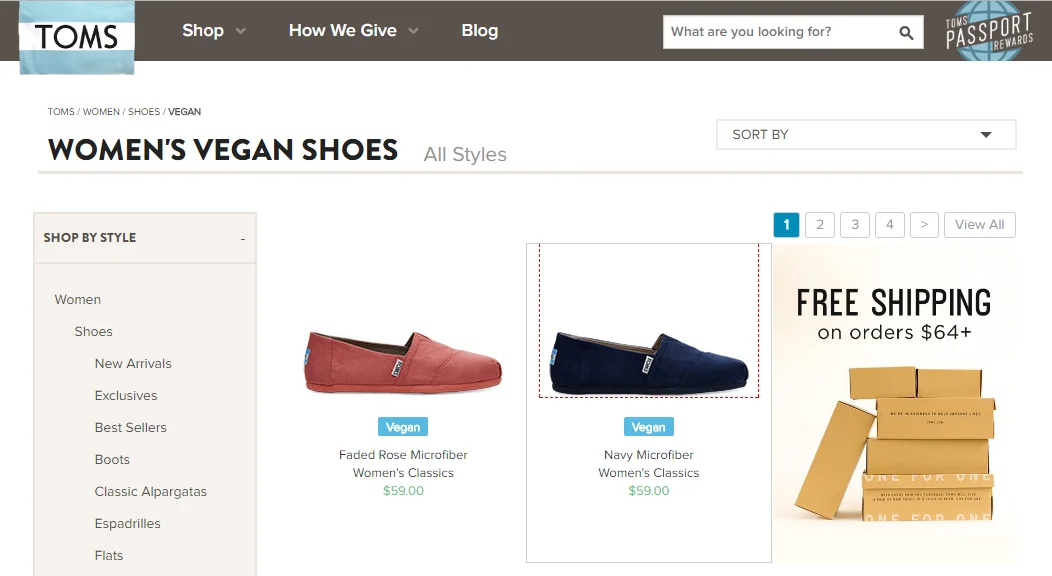
TOMS isn't but engaged in corporate philanthropy to make a quick buck; it's a core part of the company'due south values and brand.
TOMS was founded past Blake Mycoskie in 2006 post-obit a trip to Argentina. During his visit, Mycoskie saw firsthand how people living in impoverished areas of Argentina had to alive without shoes, a challenge that many of us likely give footling idea. Inspired past his trip, Mycoskie decided to establish his company with giving in heed.

Since 2006, TOMS' footwear business organization has donated more than lx meg(!) pairs of shoes to children in need all over the world. Every bit if that weren't plenty, TOMS' eyewear division has given more 400,000 pairs of glasses to visually impaired people who lack admission to ophthalmological care.
The company has farther diversified its operations to include clean h2o initiatives through its coffee business, and its line of numberless has helped support projects to expand access to birthing kits to expectant mothers in developing nations besides equally training for nascency attendants. To date, TOMS has helped more than 25,000 women safely deliver their babies.
How Does TOMS Use Upstanding Marketing?
TOMS puts its social and environmental philanthropy on total brandish in about every attribute of its branding. This not only lets potential customers know the kind of visitor they're dealing with right off the bat, simply also reinforces TOMS' brand values consistently across all channels.
Have a look at TOMS' homepage. Right underneath the carousel, the company tells you that, for every product you purchase, TOMS will help someone in need:

TOMS' mission is so central to the company's branding, it's given nearly equal emphasis on its website as the products it sells. In fact, it's almost impossible to navigate through TOMS' site without seeing further examples of how TOMS helps people around the world.
This isn't a typically cynical endeavor to capitalize on empty gestures or a feel-good sales tactic; it's the same principle leveraged by brands that apply display advertizing. Merely equally many display ads are designed to promote brand awareness and achieve top-of-heed presence among consumers, TOMS' philanthropic mission is constantly reinforced throughout its website and marketing materials. As a result, it's almost incommunicable to think of TOMS as a brand without thinking of the company's diverse outreach projects and corporate giving initiatives.
Ethical Marketing Case #2: Everlane
Wearable manufacturing is among the most controversial industries in the world. During the by 20 years or so, much greater attending has been paid to how and where our clothes are made, specially in low-cal of tragedies such as the blaze that tore through a garment manufacturing facility in Bangladesh in 2012, killing 117 people – a factory that supplied clothing to American retailers including Walmart and Sears.
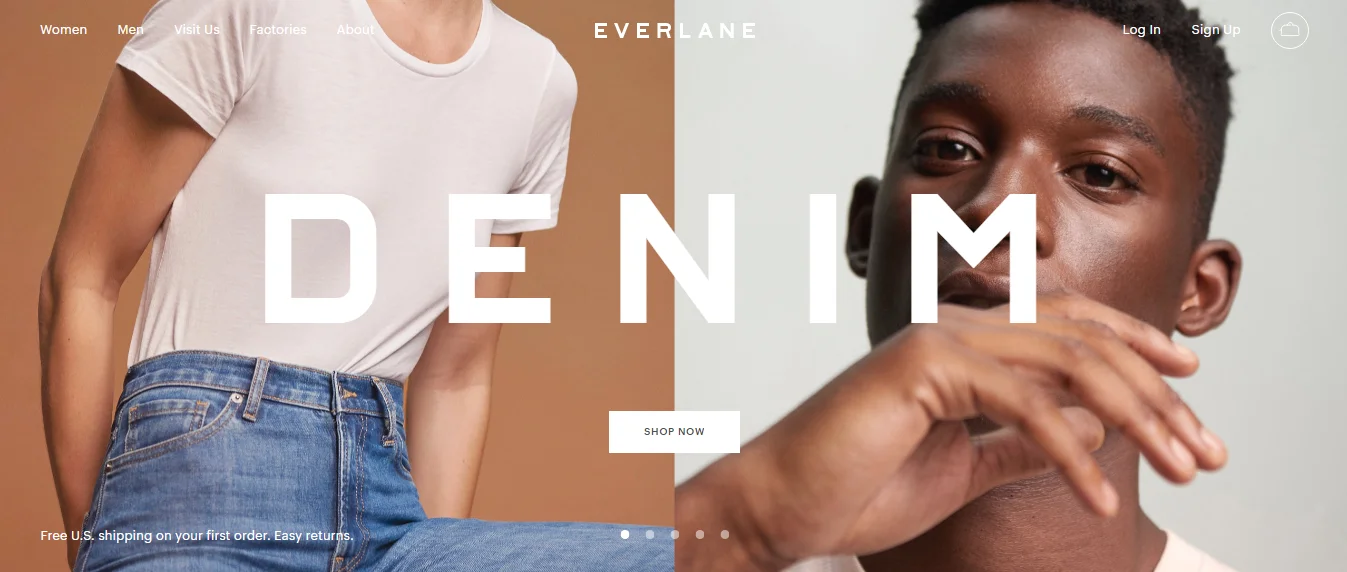
In light of greater awareness about the use of sweatshops, demand for ethically made vesture has soared in recent years, a trend that has given rise to dozens of companies that want to alter how nosotros make and view vesture, including Everlane.
Founded in 2010 by Michael Preysman, Everlane is boldly committed to upstanding manufacturing. All of Everlane's garments are made in factories that meet the most stringent quality standards – not only in terms of the dress themselves, but also in how workers are treated. Everlane just partners with manufacturers that demonstrate a strong commitment to their workers' welfare, a fact the company prides itself upon in its marketing material.
How Does Everlane Use Ethical Marketing?
Like other ethical brands, Everlane's About page tells its brand story, including how the company champions the rights and well-existence of the workers who make its wearing apparel. What's really interesting about Everlane, though, is its commitment to radical transparency.

An Everlane warehouse worker prepares garments at the company's
Mola, Inc. tee-shirt manufactory in Los Angeles, CA. Image via Everlane.
Everlane isn't content to merely tell you that its dress are manufactured and sold ethically; the company also provides customers with a detailed price breakdown for each and every one of its stylish, minimalist garments. This includes details on the cost of materials, labor, transportation and logistics, excise taxes and duties, and even hardware such as zippers and buttons.
The visitor's Elements jacket, for example, costs $60 to produce, and you can run into exactly how much each of the manufacturing and logistical elements affects the retail cost:
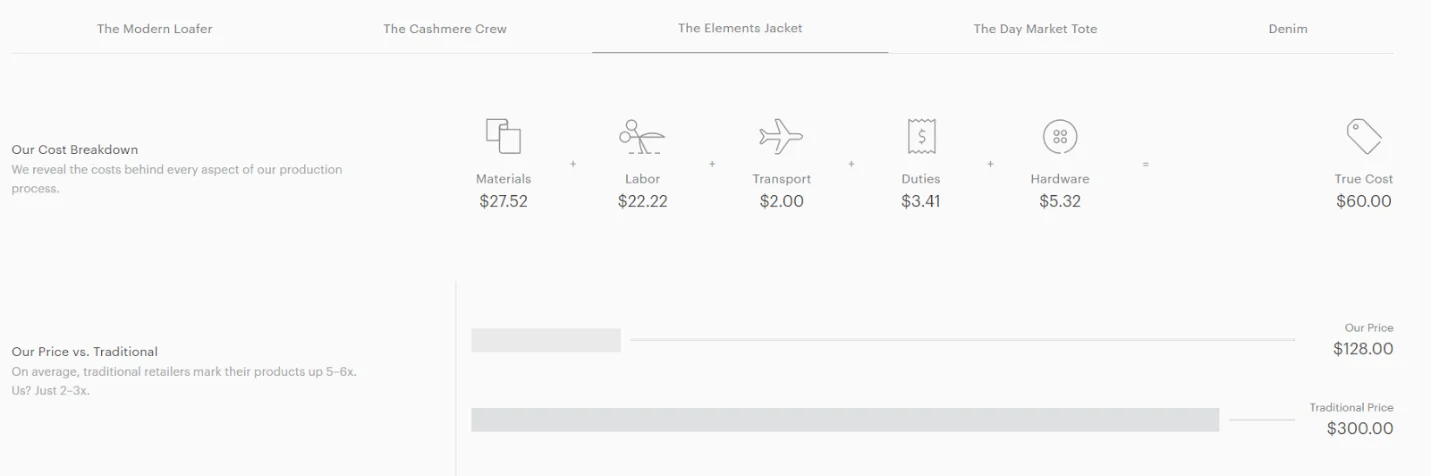
Typically, the production costs of almost commercially produced vesture are a closely guarded hugger-mugger. This isn't merely because a breakdown of such costs would reveal a make's potential turn a profit margin on a specific item, but too considering they highlight the desperately poor pay and atmospheric condition many people working in garment manufacturing endure.
Past boldly revealing precisely how much each of its garments costs to make, Everlane can offer its customers the kind of transparency consumers want while enjoying the considerable karma this kind of radical transparency offers.
Ethical Marketing Case #3: Dr. Bronner's
Consumer need for ethically produced cleansing products has intensified in contempo years, and although there are literally hundreds of brands of lather available on the market, few are as unique or memorable every bit Dr. Bronner's, the summit-selling organic liquid soap brand in America.
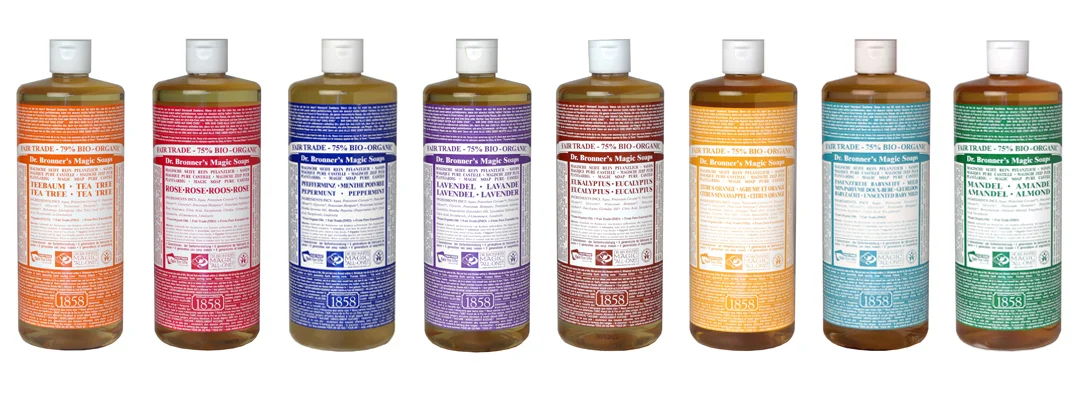
If you lot've ever bought or seen a bottle of Dr. Bronner's soap, you'll already know that the company is a little different to other soap companies. For starters, the product'south unique packaging features the company's fascinating "Cosmic Principles," a 30,000-discussion philosophical screed that company founder and self-styled doctor Emanuel Bronner spoke of while touring the The states' lecture circuit in the tardily 1940s. Bronner offered his at present-famous peppermint liquid soap as a freebie for people who attended his lectures, merely it didn't take long for him to realize most people would only turn upwards at his speeches to grab their costless sample of soap.
It wasn't just Emanuel Bronner who demonstrated a commitment to social and ecology activism. Bronner'south grandson, David, was arrested in 2012 for publicly harvesting hemp from within a locked cage outside the White House, a stunt orchestrated to protest what David Bronner felt was the federal government'due south undue oversight of hemp product in the U.s.a..
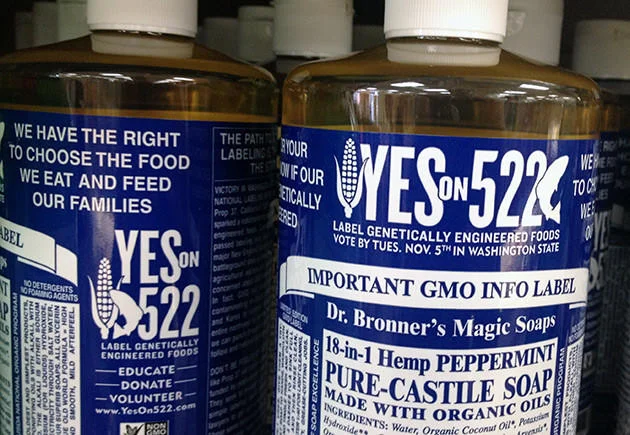
Epitome via Mother Jones
In the years since the cage incident, David Bronner has been extremely active in many areas of social and environmental justice, including the fight for greater oversight into the labeling of products that include genetically modified ingredients.
How Does Dr. Bronner'due south Employ Ethical Marketing?
Dr. Bronner's is such a unique brand because of the eccentricity of its founder. Indeed, information technology'southward hard to imagine how different the Dr. Bronner's brand would be without the "Moral ABCs" that Bronner lectured about before long after Earth State of war II.
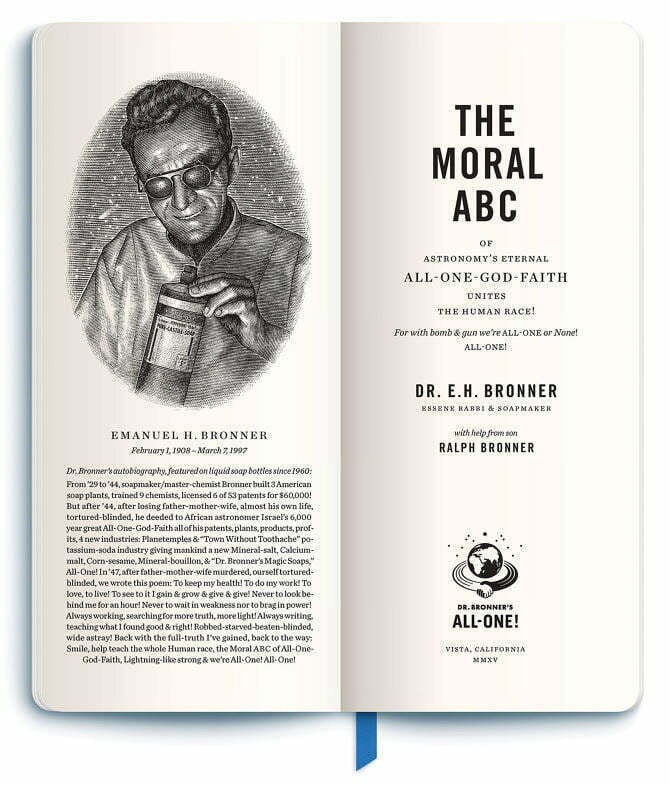
Every bit a effect of the company'due south unorthodox founding, Dr. Bronner's is uniquely positioned to leverage its history of upstanding manufacturing in its marketing. In many means, the company's iconic production packaging serves every bit the perfect introduction to the firm'southward philosophy; I often notice myself reading the Moral ABCs while showering.
Of course, the company'southward commitment to what it calls "constructive capitalism" goes far beyond its unusual packaging and mission argument. Dr. Bronner'due south is what's known as a Benefit Corporation (or B-Corp), a designation that states such companies must exist for-turn a profit operations that have a "positive touch on order and the environs according to legally defined goals."
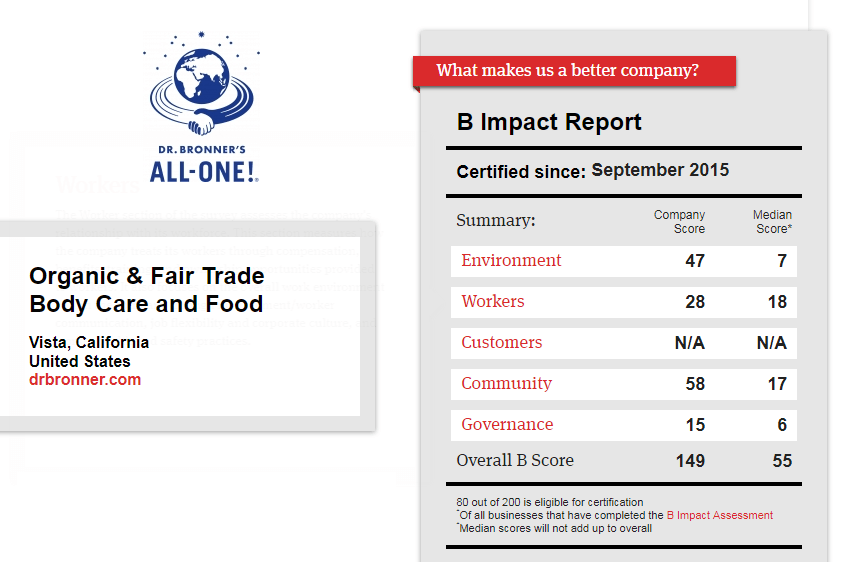
To this end, Dr. Bronner'due south succeeds admirably. The visitor is committed to several tangible objectives, including raising awareness of crucial environmental and social justice issues, the use of USDA-certified fair-trade ingredients whenever possible, and to equitable compensation structures that limit executive pay to five times that of lower-level employees. (For a little perspective, Dunkin' Donuts CEO Nigel Travis said in 2015 that paying workers a minimum wage of $15 per hour was "admittedly outrageous" despite the fact that he personally "earns" approximately $4,889 per hour.)
Ethical Marketing Example #iv: Conscious Coffees
Coffee is serious business – and I'grand non talking most lame "don't carp me earlier I've had my beginning cup" jokes. Globally, the coffee industry direct supports the livelihoods of more 120 million of the world's poorest people, and few industries are likely to experience the kind of disruption wrought by climatic change as intensely as agricultural coffee production; in worrisome news for the constantly caffeinated, literally half the world's coffee farming country could be lost by 2050 if climate change isn't tackled aggressively.
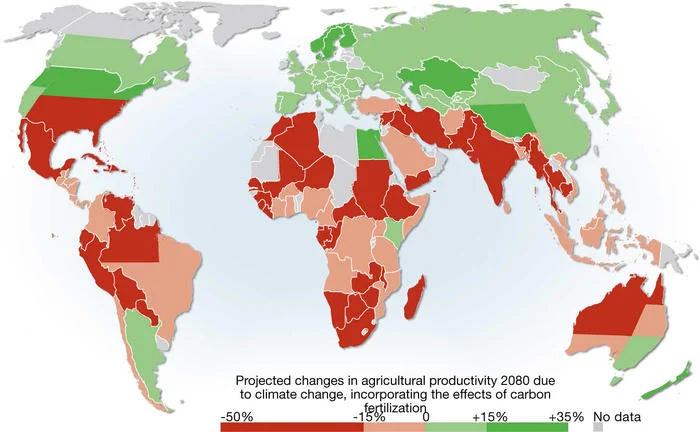
Image via Global Agriculture
To that end, many companies are seeking to ameliorate atmospheric condition for java farmers and producers around the globe, and ane of the best is Conscious Coffees. Headquartered in Boulder, Colorado, Conscious Coffees was founded in 1996 by Mark and Melissa Glenn, who later sold the business to current owner Craig Lamberty earlier this year.
Since its founding, Witting Coffees has worked tirelessly to improve its product pipelines to benefit growers, farmers, and suppliers beyond South America. Like Dr. Bronner's, Conscious Coffees is a certified B-Corporation, and earned a community bear upon score in the top ten% of all certified B-Corporations worldwide for its work.
How Does Conscious Coffees Use Ethical Marketing?
Everything virtually Witting Coffees, from its name to its logo, reinforces the company's mission and ethical production philosophy – then much and so that Conscious Coffees doesn't use ethical marketing as much equally it embodies the principle as a make.
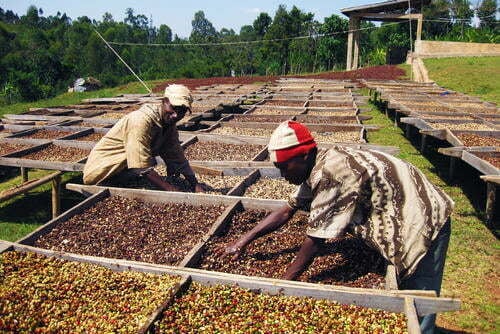
Conscious Coffees-affiliated growers preparing java beans.
Image via Conscious Coffees.
In improver to its potent commitment to ethical production processes and off-white-merchandise commerce, Conscious Coffees engages in a wide range of community outreach initiatives.
Its CAFE Livelihoods Program empowers people in El salvador, Guatemala, Mexico, and Nicaragua to ain and operate their ain coffee businesses through grooming workshops and ongoing guidance and support. The company regularly donates java to the local Customs Cycles program, a project run by cycling enthusiasts from beyond the Boulder region who help other cyclists with repairs, maintenance, and refurbishment of onetime and used bicycles. Witting Coffees' team of coffee experts offering technical advice and support to growers and farmers equally part of the USAID-funded Farmer-to-Farmer initiative, which helps coffee growers across South America learn new techniques that tin aid them maximize yields and engage in fair-trade economical practices with North American suppliers.

Bicycle enthusiasts at a Community Cycles event. Prototype via
Conscious Coffees.
Witting Coffees is the perfect instance of a make that not only uses ethical marketing practices, simply embodies them in everything it does.
Ethical Marketing Example #5: Farmer Direct Co-op
Always watch one of those nutrient documentaries on Netflix virtually industrialized agriculture? If so, you'll already know that farming is not but one of the hardest jobs in North America, but that it's too one of the well-nigh unethical industries. From corporate strong-arming of family owned farms by huge corporations to the apple-polishing cruelty and misery inflicted on livestock, farming is a far weep from the bucolic, pastoral scenes presented to united states of america on the packaging of many foods in our local supermarkets.

That's what makes central Canada's Farmer Direct Co-op and so heady. An entirely worker-owned cooperative, Farmer Direct is farming with a mission. The cooperative'southward network of more than 60 privately owned and operated farms across southern Alberta, Manitoba, and Saskatchewan is firmly committed to truly sustainable agriculture and responsible environmental stewardship. The co-op is affiliated with several organizations with a focus on sustainable farming, including the Cornucopia Establish and the Fair World Project.

In terms of what Farmer Straight actually sells, all of the co-op's produce is certified organic, and includes produce such as beans, peas, and oats, all of which are sold at Whole Foods locations across North America.
How Does Farmer Direct Use Upstanding Marketing?
Similar all of the examples to a higher place, ethical marketing lies at the centre of Farmer Direct's operations. In addition to its vibrant, agile social media presence (through which Farmer Direct offers a range of healthy eating tips, recipes, and other fun content), Farmer Straight maintains a lively blog and newsletter, both of which serve as further opportunities to aid people make meliorate decisions virtually their food and live a more conscientious lifestyle as consumers.
Maybe a little unusually for an agricultural arrangement, Farmer Direct also maintains a surprisingly good Pinterest profile, which is always bang-up to see alongside the mainstays of Facebook and Twitter.

Farmer Direct's mission may be a lilliputian more challenging than that of the other companies featured in this post. Not considering they're not trying to sell something (they are), or because there's no demand for organic, authentically grown produce (there is), simply because they want to change the way people think about food and where our nutrient comes from. This is a much longer-term goal, and a actually aggressive one, too. Industrialized agriculture has transformed the manner we eat – and non in a good way.
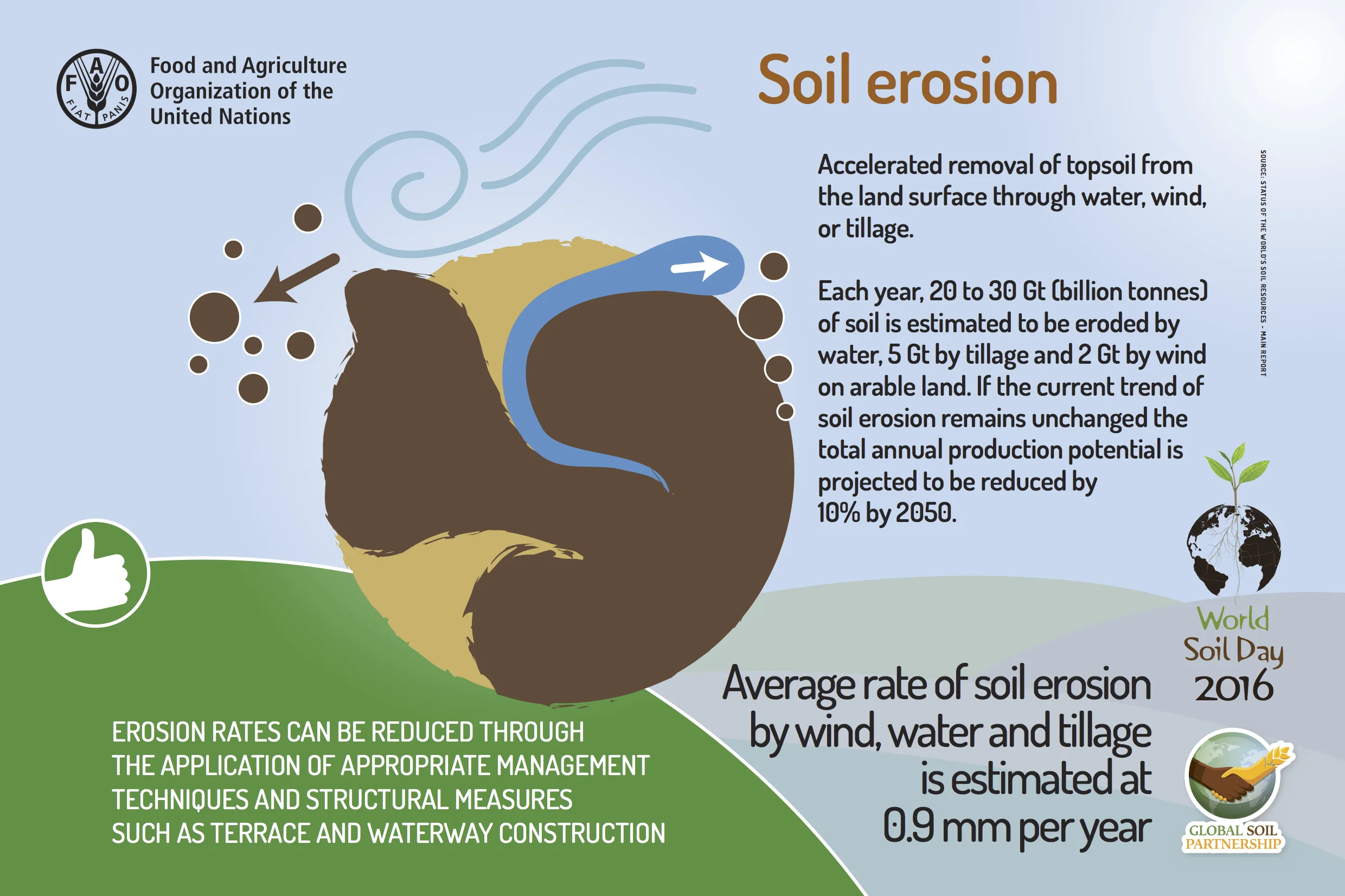
Image via Food and Agriculture Arrangement of the
United nations
Another element of Farmer Direct's ethical marketing that's worth mentioning is its strong dedication to truly sustainable agriculture from an ecology perspective. Many farms emphasize their organic certifications or their beautiful pastures where their livestock are complimentary to roam and wander, just Farmer Directly wants to raise awareness of how factors such equally topsoil erosion can devastate rural farming communities and even private farms.
Businesses Can Do Practiced AND Do Well
Although each of the businesses featured in this mail service are distinctly different, they all share a common characteristic: a delivery to giving back and protecting the rights and livelihoods of some of the world'south most vulnerable people. These companies have embraced upstanding marketing not as a cheap gimmick they tin can exploit to bulldoze sales, but every bit a cadre part of their mission and values as organizations.
Ethical marketing relies on a long-term strategy of continuing education, campaigning, and activism. It'due south near helping consumers make better, more conscious choices about the products they buy and the stores they frequent. It's nigh irresolute the fashion we recollect about how goods are provided, the people who make and sell the things nosotros buy every day, and the communities that rely on fair, ethical merchandise to survive. Information technology's about cultivating brand loyalty by aligning your organizational values with those of your ideal customers.
Hopefully these examples have given y'all some ideas on how you can develop and incorporate philanthropic principles in your own organization. Not every company will be suited to ethical marketing – there are no fair trade plumbers, after all – but those that are may find that focusing on people and not just turn a profit could be a wise investment.
Source: https://www.wordstream.com/blog/ws/2017/09/20/ethical-marketing
0 Response to "what is likely the single most effective step that company can take to set ethical standards?"
Post a Comment