The Last Stage of the Calvin Cycle Acts to Recycle ______
What is photosynthesis?
Photosynthesis is the process used by plants, algae and certain bacteria to turn sunlight, carbon dioxide (CO2) and h2o into nutrient (sugars) and oxygen. Here's a look at the full general principles of photosynthesis and related research to help develop clean fuels and sources of renewable energy.
Types of photosynthetic processes
There are 2 types of photosynthetic processes: oxygenic photosynthesis and anoxygenic photosynthesis. They both follow very like principles, but oxygenic photosynthesis is the well-nigh mutual and is seen in plants, algae and cyanobacteria.
During oxygenic photosynthesis, light free energy transfers electrons from water (H2o) taken up past constitute roots to CO2 to produce carbohydrates. In this transfer, the CO2 is "reduced," or receives electrons, and the h2o is "oxidized," or loses electrons. Oxygen is produced along with carbohydrates.
Oxygenic photosynthesis functions as a weigh to respiration by taking in the CO2 produced by all breathing organisms and reintroducing oxygen to the atmosphere.
Anoxygenic photosynthesis, meanwhile, uses electron donors that are not water and do not produce oxygen, according to "Anoxygenic Photosynthetic Bacteria" past LibreTexts. The process typically occurs in bacteria such as green sulfur bacteria and phototrophic imperial bacteria.
The Photosynthesis equation
Though both types of photosynthesis are complex, multistep affairs, the overall process tin can exist neatly summarized as a chemical equation.
The oxygenic photosynthesis equation is:
6CO2 + 12H2O + Light Energy → C6H12O6 + 6O2 + 6H2O
Here, six molecules of carbon dioxide (CO2) combine with 12 molecules of h2o (H2O) using low-cal energy. The finish result is the formation of a single carbohydrate molecule (C6H12O6, or glucose) along with six molecules each of oxygen and water.
Similarly, the various anoxygenic photosynthesis reactions tin exist represented as a unmarried generalized formula:
CO2 + 2H2A + Light Energy → [CH2O] + 2A + H2o
The alphabetic character A in the equation is a variable, and H2A represents the potential electron donor. For example, "A" may represent sulfur in the electron donor hydrogen sulfide (H2S), co-ordinate to medical and life sciences news site News Medical Life Sciences.
How is carbon dioxide and oxygen exchanged?
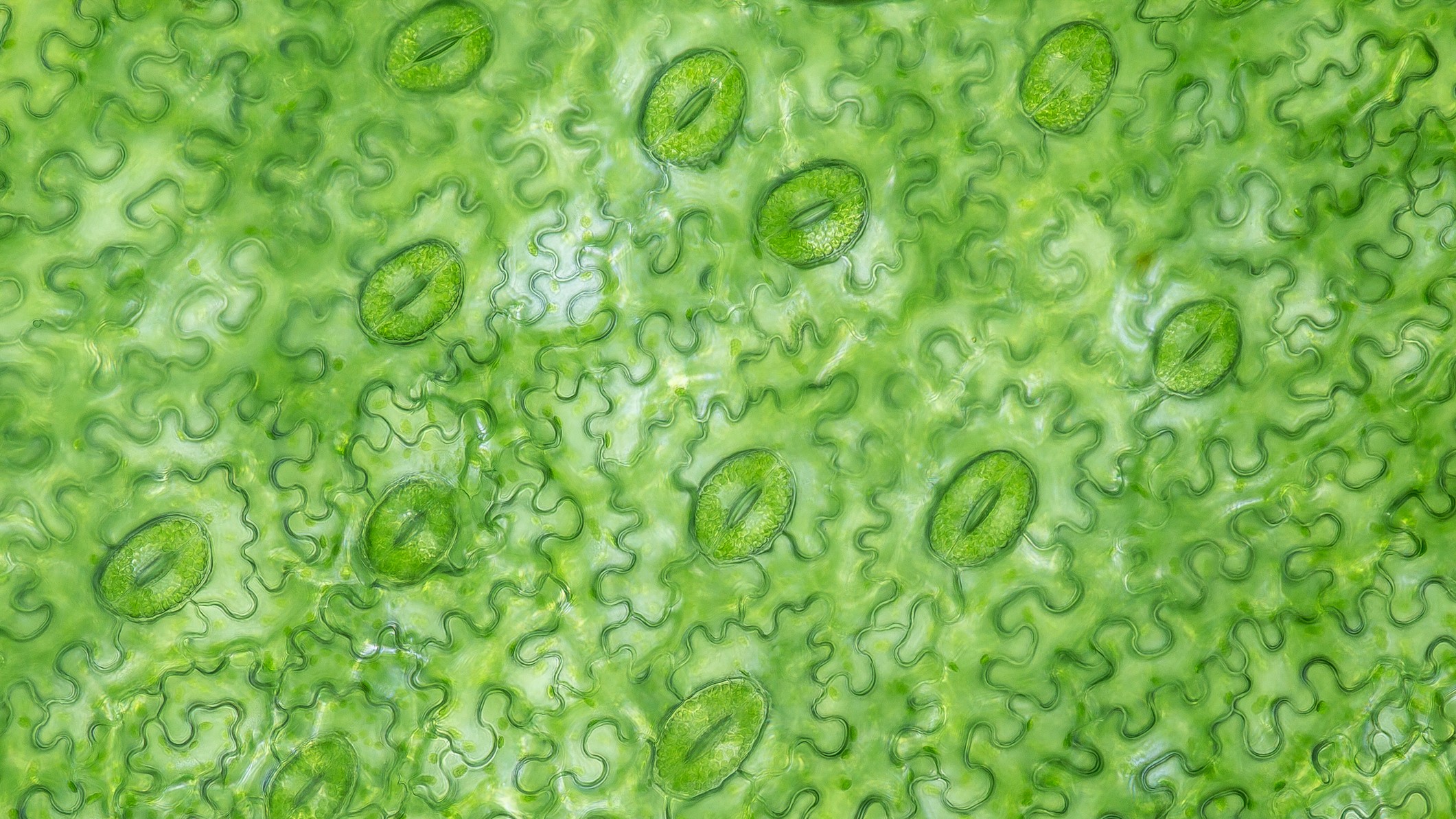
Plants absorb CO2 from the surrounding air and release water and oxygen via microscopic pores on their leaves chosen stomata. Stomata are the gatekeepers of gas commutation betwixt the inside of plants and the external environment.
When stomata open, they permit in CO2; nevertheless, while open, the stomata release oxygen and let water vapor escape. In a bid to reduce the corporeality of h2o lost, stomata close, but that means the plant can no longer gain CO2 for photosynthesis. This tradeoff between CO2 gain and water loss is a particular problem for plants growing in hot, dry environments.
How do plants absorb sunlight for photosynthesis?
Plants incorporate special pigments that blot the lite free energy needed for photosynthesis.
Chlorophyll is the primary pigment used for photosynthesis and gives plants their green color, according to scientific discipline teaching site Nature Educational activity. Chlorophyll absorbs cherry-red and blueish light to use in photosynthesis and reflects light-green low-cal. Chlorophyll is a large molecule and takes a lot of resources to make; as such, information technology breaks down towards the end of the leafage'south life, and nearly of the pigment'south nitrogen (one of the building blocks of chlorophyll) is resorbed back into the plant, according to Harvard University's The Harvard Forest. When leaves lose their chlorophyll in the fall, other leafage pigments such every bit carotenoids and anthocyanins begin to bear witness their true colors. While carotenoids primarily absorb blue light and reflect yellow, anthocyanins absorb blue-green calorie-free and reverberate red lite.
Paint molecules are associated with proteins, which allow them the flexibility to move toward low-cal and toward one another. A large collection of 100 to v,000 pigment molecules constitutes an "antenna," co-ordinate to an article by Wim Vermaas, a professor at Arizona State University. These structures effectively capture lite energy from the sun, in the grade of photons.
The situation is a fiddling different for bacteria. While cyanobacteria contain chlorophyll, other bacteria, for example, royal bacteria and light-green sulfur bacteria, contain bacteriochlorophyll to absorb light for anoxygenic photosynthesis, according to "Microbiology for Dummies" (For Dummies, 2019).
Related: What if humans had photosynthetic skin?
Where in the plant does photosynthesis have place?
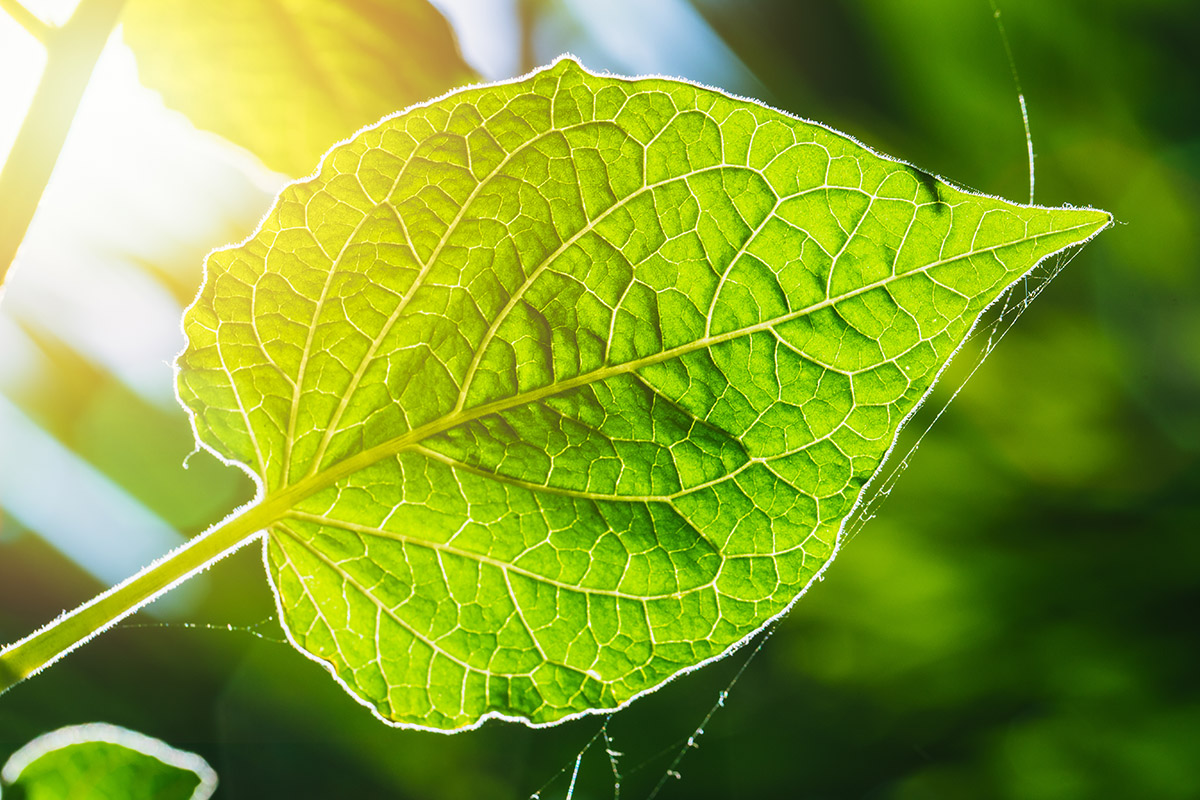
Photosynthesis occurs in chloroplasts, a type of plastid (an organelle with a membrane) that contains chlorophyll and is primarily found in plant leaves. Double-membraned plastids in plants and algae are known equally primary plastids, while the multiple-membraned variety found in plankton are called secondary plastids, according to a 2010 article in the journal Nature Teaching by Cheong Xin Chan and Debashish Bhattacharya, researchers at Rutgers University in New Jersey.
Chloroplasts are like to mitochondria, the energy centers of cells, in that they have their own genome, or collection of genes, independent inside round DNA. These genes encode proteins that are essential to the organelle and to photosynthesis.
Inside chloroplasts are plate-shaped structures called thylakoids that are responsible for harvesting photons of low-cal for photosynthesis, according to the biology terminology website Biological science Online. The thylakoids are stacked on pinnacle of each other in columns known equally grana. In between the grana is the stroma — a fluid containing enzymes, molecules and ions, where sugar formation takes place.
Ultimately, light energy must be transferred to a paint-protein circuitous that can catechumen it to chemic energy, in the grade of electrons. In plants, calorie-free energy is transferred to chlorophyll pigments. The conversion to chemical energy is achieved when a chlorophyll pigment expels an electron, which can then move on to an appropriate recipient.
The pigments and proteins that catechumen low-cal energy to chemic free energy and begin the process of electron transfer are known as reaction centers.
The reactions of institute photosynthesis are divided into 2 major stages: those that require the presence of sunlight (low-cal-dependent reactions) and those that do non (light-independent reactions). Both types of reactions take identify in chloroplasts: light-dependent reactions in the thylakoid and lite-independent reactions in the stroma.
Light-dependent reactions
When a institute absorbs solar energy it start needs to convert it into chemical energy.
When a photon of low-cal hits the reaction center, a paint molecule such every bit chlorophyll releases an electron.
The released electron manages to escape past traveling through an electron transport chain, which generates the energy needed to produce ATP (adenosine triphosphate, a source of chemic energy for cells) and NADPH — both of which are required in the next phase of photosynthesis in the Calvin wheel. The "electron hole" in the original chlorophyll pigment is filled past taking an electron from h2o. This splitting of water molecules releases oxygen into the atmosphere.
Light-contained reactions: The Calvin bike
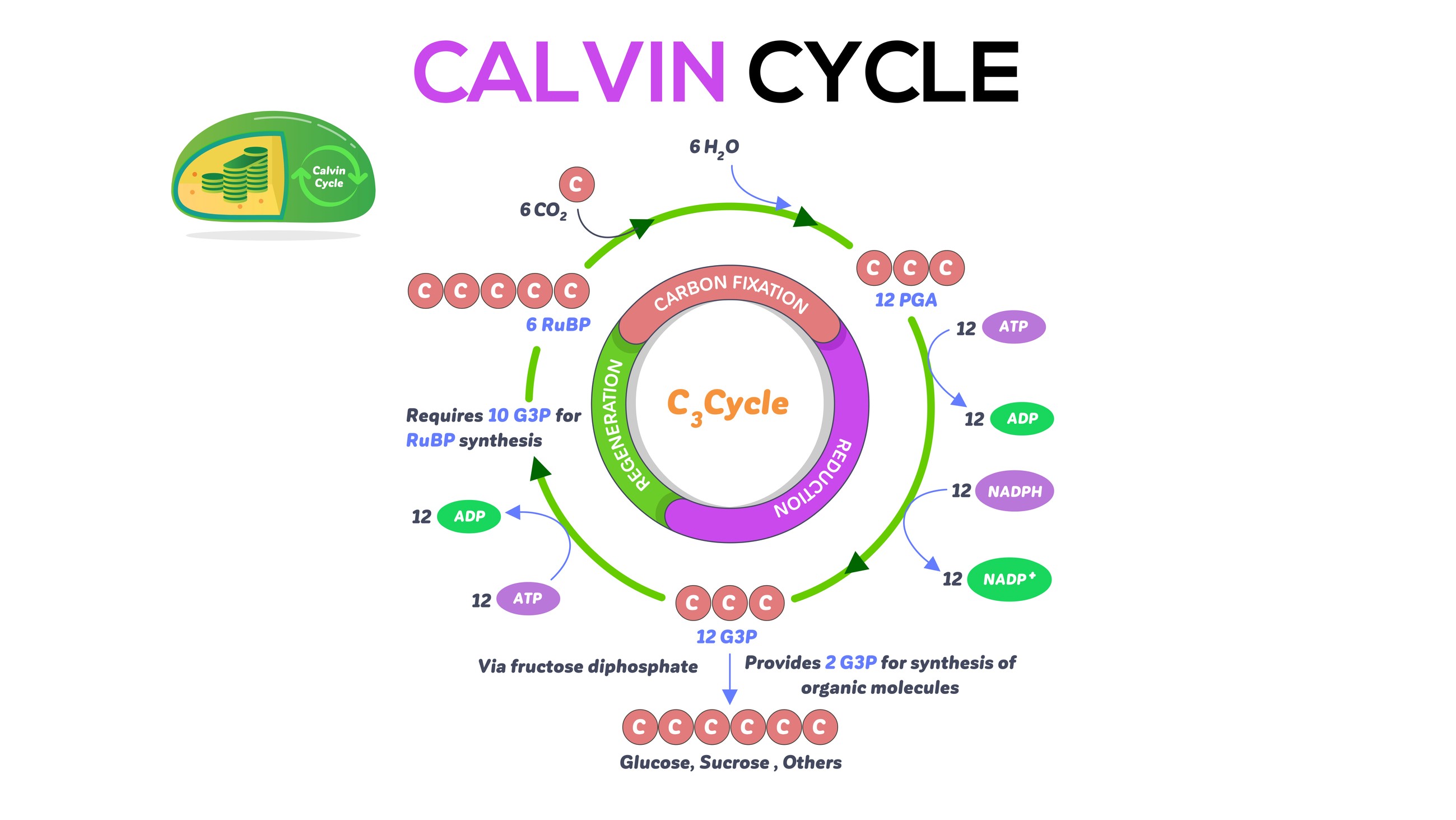
The Calvin bike uses energy stored from the light-dependent reactions to fix CO2 into sugars needed for plant growth. According to the Khan Academy, these reactions take place in the stroma of the chloroplasts and are not directly driven past calorie-free — hence their proper noun "light-independent reactions." However, they are still related to light as the Calvin cycle is fuelled by ATP and NADPH (both from the previously mentioned calorie-free-dependent reactions).
Firstly, CO2 combines with ribulose-1,5-bisphosphate (RuBP) which is a five-carbon acceptor, according to the Khan Academy. Next, it splits into two molecules of a 3-carbon chemical compound — three-phosphoglyceric acid (three-PGA). The reaction is catalyzed by an enzyme called RuBP carboxylase/oxygenase, also known as rubisco.
The second stage of the Calvin cycle involves converting 3-PGA into a three-carbon sugar chosen glyceraldehyde-3-phosphate (G3P) — the process uses ATP and NADPH. Finally, while some G3P molecules are used to make glucose, others are recycled dorsum to brand RuBP, which is used in the first step to accept CO2. For every one molecule of G3P that makes glucose, v molecules are recycled to generate three RuBP acceptor molecules.
Photorespiration
According to the Khan University, rubisco tin can sometimes set up oxygen instead of CO2 in the Calvin bicycle, which wastes energy — a procedure known as photorespiration. The enzyme evolved during a time when atmospheric CO2 levels were high and oxygen was rare, so it had no reason to differentiate betwixt the ii, according to researchers in Canada.
Photorespiration is a specially big problem when plants have their stomata closed to conserve water and are therefore not taking in any more than CO2. Rubisco has no other option but to fix oxygen instead, which in plough lowers the photosynthetic efficiency of the plant. This ways that less plant food (sugars) will be produced, which could result in a slowdown of growth and therefore smaller plants.
This is a big problem for agriculture, as smaller plants mean a smaller harvest. There are mounting pressures on the agricultural industry to increase institute productivity to feed our ever-expanding global population. Scientists are constantly looking for ways to increment photosynthetic efficiency and reduce the occurrence of wasteful photorespiration.
Types of photosynthesis
There are 3 master types of photosynthetic pathways: C3, C4 and CAM. They all produce sugars from CO2 using the Calvin cycle, merely each pathway is slightly different.

C3 photosynthesis
Almost plants use C3 photosynthesis, according to the photosynthesis enquiry project Realizing Increased Photosynthetic Efficiency (RIPE), including cereals (wheat and rice), cotton wool, potatoes and soybeans. C3 photosynthesis is named for the 3-carbon compound chosen three-phosphoglyceric acid (3-PGA) that information technology uses during the Calvin cycle. iii-PGA is produced when rubisco fixes CO2, forming the iii-carbon compound.
C4 photosynthesis
Plants such as maize and sugarcane apply C4 photosynthesis. This process uses a 4-carbon compound intermediate (called oxaloacetate) which is converted to malate, according to Biological science Online. Malate is then transported into the bundle sheath where it breaks downward and released CO2, which is so fixed by rubisco and made into sugars in the Calvin cycle (merely like C3 photosynthesis). C4 plants are better adapted to hot, dry environments and can go along to fix carbon even when their stomata are closed (as they have a clever storage solution), which reduces their risk of photorespiration, according to Biology Online.
CAM photosynthesis
Crassulacean acid metabolism (CAM) is institute in plants adjusted to very hot and dry environments, such as cacti and pineapples, co-ordinate to the educational website Khan Academy. When stomata open up to take in CO2, they risk losing water to the external environment. Because of this, plants in very arid and hot environments have adapted. I adaptation is CAM, whereby plants open stomata at nighttime (when temperatures are lower and h2o loss is less of a hazard). Co-ordinate to the Khan Academy, CO2 enters the plants via the stomata and is fixed into oxaloacetate and converted into malate or some other organic acid (like in the C4 pathway). The CO2 is then available for low-cal-dependent reactions in the daytime, and stomata shut, reducing the chance of water loss.
How photosynthesis could combat climate change
Photosynthetic organisms are a possible means to generate clean-burning fuels such every bit hydrogen. A research grouping at the University of Turku in Finland tapped into the ability of green algae to produce hydrogen. Greenish algae tin can produce hydrogen for a few seconds if they are first exposed to dark, anaerobic (oxygen-free) conditions and then exposed to light. The researchers devised a way to extend greenish algae's hydrogen product for up to 3 days, as reported in their 2018 study published in the journal Free energy & Environmental Science.
Scientists accept as well made advances in the field of artificial photosynthesis. For instance, a group of researchers from the Academy of California, Berkeley, developed an bogus system to capture CO2 using nanowires, or wires that are a few billionths of a meter in diameter. The wires feed into a arrangement of microbes that reduce CO2 into fuels or polymers by using energy from sunlight. The team published its blueprint in 2015 in the journal Nano Letters.
In 2016, members of this aforementioned group published a written report in the journal Science that described some other bogus photosynthetic arrangement in which especially engineered bacteria were used to create liquid fuels using sunlight, h2o and CO2. In full general, plants are but able to harness about i percent of solar energy and use it to produce organic compounds during photosynthesis. In dissimilarity, the researchers' artificial organisation was able to harness ten% of solar energy to produce organic compounds.
In 2019, researchers wrote in the Journal of Biological Chemistry that cyanobacteria could boost the efficiency of the enzyme rubisco. Scientists constitute that this bacteria is particularly good at concentrating CO2 in its cells, which helps stop rubisco from accidentally binding to oxygen. By understanding how the bacteria accomplish this, scientists hope to incorporate the mechanism into plants to assist boost photosynthetic efficiency and reduce the risk of photorespiration.
Continued inquiry of natural processes aids scientists in developing new ways to utilize diverse sources of renewable free energy, and tapping into the ability of photosynthesis is a logical step for creating clean-burning and carbon-neutral fuels.
Additional resource
- Discover more facts virtually photosynthesis with the educational science website sciencing.com.
- Explore how leafage structure affects photosynthesis with The University of Arizona.
- Larn about the different ways photosynthesis tin be measured with the educational science website Scientific discipline & Plants for Schools.
Source: https://www.livescience.com/51720-photosynthesis.html
0 Response to "The Last Stage of the Calvin Cycle Acts to Recycle ______"
Post a Comment