What Complications Can Occur From Antibiotic Resistance, Both in Humans and in Livestock?
Antibiotic Resistance in Humans and Animals
June 22, 2022 | Discussion Paper
Introduction
Information technology has been 40 years since Levy and colleagues published their landmark study demonstrating a direct link betwixt antibiotic use on farms and the spread of antibiotic resistance to human being populations (Levy et al., 1976). That report prospectively followed bacteria in farm animals and farm workers after the introduction of tetracycline-supplemented feed. Within ii weeks, the bacteria found in the guts of animals fed the tetracycline supplement were nigh all tetracycline-resistant (a marked modify from baseline). Those tetracycline-resistant bacteria spread to the subcontract's laborers such that inside 6 months, the laborers' stool independent more than than fourscore pct tetracycline-resistant bacteria, compared to less than 7 percent found in samples from neighbors. Furthermore, vi months after the tetracycline-supplemented feed was removed, the tetracycline-resistant microbes had disappeared entirely from the intestines of all but 2 of the 10 farm workers tested and was barely detectable (5 pct of isolates) in one of those two workers.
Thus, we have known definitively for more than twoscore years that antibiotic usage in livestock results in the straight spread of antibiotic-resistant bacteria to humans. In the ensuing decades, numerous studies have been published in peer-reviewed scientific literature providing boosted bear witness of the spread of antibody-resistant microbes from livestock animals into the nutrient supply or to humans (CDC, 2013b; Davis and Price, 2016; Elliott, 2015; Marshall and Levy, 2011; O'Neill, 2015; Robinson et al., 2016; Sneeringer et al., 2015). Indeed a recent report commissioned by the British government concluded the following:
Of . . . 92 papers, 114 (59 percentage) openly stated or contained evidence to advise that antibody utilise in agronomics increases the number of resistant infections in humans. Simply 15 (viii per centum) argued that there was no link between antibody use and resistance. The other 63 did not take a clear stance. Further to this, the bulk of studies opposing a reduction of agronomical antimicrobial use were authored by people affiliated to either governments or industry, in contrast to the majority of studies that were affiliated to universities. Of the 139 academic studies the Review plant, only seven (five percentage) argued that at that place was no link between antibody consumption in animals and resistance in humans, while 100 (72 percent) found evidence of a link. . . . In light of this information, we believe that there is sufficient evidence showing that the earth needs to start curtailing the quantities of antimicrobials used in agriculture now. Where gaps in the bear witness remain, they should be filled. Only given all that we know already, it does not make sense to delay action further: the burden of proof should be for those who oppose curtailing the employ of antimicrobials in food product to explain why, not the other way around (O'Neill, 2015).
The consummate failure of our club to address this business in the United States is profoundly disappointing and alarming to providers who increasingly struggle to intendance for patients infected with antibiotic-resistant leaner. Apologists abound. Excuses are rampant. As alluded to by the British report, "more scientific discipline" is the often-heard refrain. Those who espouse the need for yet further study before action tin can be taken typically have shut links to farms that continue to utilize antibiotics. Yet nosotros are past the scientific tipping indicate.
The issue at hand is one of policy. All policy bug are matters of choosing between pros and cons, risks and benefits. Policy makers most never have a perfect understanding of all variables at play, nor is it necessary for them to have such precision of information to make choices. Waiting for perfect science is not possible either, because science is constantly in a state of evolution of noesis based on changing research. Thus, nosotros seek here to summarize the country of the problem in human terms and to inform policy makers of the risks and benefits of taking action or not.
The Current Land of Antibody Resistance
Society is undoubtedly facing a crisis of antibiotic resistance. Distinguished bodies raising the alarm over antibiotic resistance include the World Health Organization, the U.South. Centers for Illness Control and Prevention, the European Centre for Disease Prevention and Control, the European Medicines Bureau, the Institute of Medicine, the World Economic Forum, and the U.S. Presidential Advisory Council on Science and Applied science (CDC, 2013b; European Center for Illness Prevention and Control, 2013; IOM, 2010; PCAST, 2014; WHO, 2012, 2014; World Economical Forum, 2013).
Antibiotics are among the well-nigh potent life-saving interventions in all of medicine. The reductions in death afforded by effective antibiotics for bacterial infections of all types, ranging from uncomplicated peel infections to infections of the bloodstream, lung, abdomen, and brain, are enormous (Spellberg, 2010; Spellberg et al., 2011). Within a few years of their availability, antibiotics had reduced the rate of death from infections in the The states past about 80 pct, from 280 to sixty deaths per 100,000 population (Spellberg, 2010). The availability of effective antibiotics is necessary to enable mod medical advances that range from intensive care unit medicine to aggressive surgeries, cancer chemotherapy, care for premature neonates, and organ transplantation. Loss of antibiotic efficacy threatens to render society to a time when one in 10 patients with a skin infection died and one in iii patients with pneumonia died (greater than 10-fold higher death rates compared to the antibiotic era (Spellberg, 2010; Spellberg et al., 2008b; Spellberg et al., 2009). Without effective antibiotics, medicine would be paralyzed by an inability to care for infections resulting from intensive specialty care (Spellberg, 2010; Spellberg et al., 2008a; Spellberg et al., 2011; Spellberg et al., 2013).
The U.S. Centers for Disease Control and Prevention very conservatively estimates that 23,000 Americans die of antibiotic-resistant infections each year (CDC, 2013b). The real number may well be four times that much (IDSA, 2004; Spellberg et al., 2008a; Spellberg et al., 2011). The almanac cost in the United States of such infections exceeds $xx billion per year (CDC, 2013b). Such infections are not abstract bug for the hereafter; hospital-based health care providers see them every mean solar day. We daily see infections resistant to offset-line antibiotics, and we non infrequently see infections resistant to every antibiotic except colistin or tigecycline, two antibiotics that are highly undesirable considering of excess toxicity and inadequate efficacy. We are also now seeing pan-resistant infections that are not treatable even with colistin or tigecycline.
The types of bacteria that cause many of these infections are plant in livestock. Enterobacteriaceae found in livestock and on retail meat include the opportunistic pathogensEscherichia coli and Klebsiella (Davis and Toll, 2016; Davis et al., 2015; Nordstrom et al., 2013), which are the most common causes of urinary tract infections and amidst the near common causes of bloodstream infections in patients (Davis and Toll, 2016; Diekema et al., 2003; Laupland and Church, 2014; Laupland et al., 2007; Russo and Johnson, 2003; Wisplinghoff et al., 2004). Staphylococcus aureus, the almost mutual cause of peel infections and second near common cause of bloodstream infections in patients (Beck and Frazier, 1995; Carratala et al., 2003; Diekema et al., 2001; Sigurdsson and Gudmundsson, 1989; Wisplinghoff et al., 2003a; Wisplinghoff et al., 2003b; Wisplinghoff et al., 2004), is also constitute on the pare of livestock and on retail meat (Smith, 2015; Smith and Wardyn, 2015). These organisms movement hands betwixt subcontract animals and humans and besides from humans to other humans in the community and in health care settings. Such gut and skin leaner account for a significant proportion of the antibiotic-resistant infections and resulting deaths in the United states of america and throughout the world. Furthermore, they can serve as repositories for genetic information encoding resistance that can and then spread to other types of bacteria that infect humans.
We have a crisis of antibiotic resistance. The problem is multifactorial and cannot be addressed by one intervention. A multipronged arroyo will be required to combat antibody resistance (Spellberg et al., 2013). Discussion of the status of the antibiotic pipeline is beyond the scope of this paper; even so, we and others have extensively written virtually it in the past (Spellberg, 2008, 2009, 2010; Spellberg et al., 2011; Spellberg et al., 2013). The fundamental point is that the antibiotic pipeline is unlikely to achieve the robustness of the by because of a combination of scientific, economic, and regulatory challenges. We will not be bailed out by new antibiotics coming to market. Thus nosotros accept no option—we must become far more than effective at preserving the precious antibiotics we currently have.
The Principle of Societal Trust
Equally nosotros consider the framework of policy solutions to combat antibiotic resistance, at that place is a fundamental principle that must be at the centre of our efforts. Antibiotics are unique amid all drugs, and virtually unique among all technologies, in that they endure from transmissible loss of efficacy over time (Spellberg, 2011; Spellberg et al., 2013; Spellberg et al., 2016). Because antibiotic-resistant bacteria spread from person to person, every private'southward use of antibiotics affects the ability of every other person to use the same antibiotics. Your use of an antibiotic affects our ability to use them. Our utilize affects your grandchildren's futurity power to use them. Antibiotics are therefore a shared societal trust or property. It is not acceptable for 1 group of people to abuse this trust for the purpose of perceived economic advantage, while harming anybody else.
In Western civilization, the rights of the individual accept been paramount since the Magna Carta and the establishment of common law principles. In one case an private's deportment negatively affect others, notwithstanding, limits are placed on those freedoms. For example, in the United States we recognize the rights of adults to swallow alcohol, even upwardly to the indicate of drinking themselves to death. Still, no person has the right to potable booze while driving a auto, flying a plane, or doing surgery. The former affects only the private. The latter affects others in society. The principle behind antibiotic usage is the aforementioned. Nosotros have the right to utilise them to benefit patients, only not to abuse them for perceived financial advantage (which may well be a false perception anyway, as discussed further below), in the process harming others.
Alexander Fleming, the discoverer of penicillin, warned the public virtually abuse of antibiotics in a 1945 New York Times interview. He said, "The microbes are educated to resist penicillin and a host of penicillin-fast organisms is bred out. . . . In such cases the thoughtless person playing with penicillin is morally responsible for the death of the human being who finally succumbs to infection with the penicillin-resistant organism. I promise this evil can be averted" (Penicillin's finder assays its future, 1945). Thus, 71 years ago, the man who brought penicillin to civilization also brought into specific relief the moral consequences of abusing this precious, societal trust.
Antibody Usage on the Farm
It has been known since the late 1940s that feeding sub-therapeutic concentrations of antibiotics to livestock causes them to grow bigger, faster, and less expensively (Coates et al., 1951; Elliott, 2015; Moore et al., 1946; Sneeringer et al., 2015; Stokstad and Jukes, 1950). The machinery of this event remains unclear after more than 60 years. Recent show from mice suggests that the effect may be due to alterations in the intestinal microbiota, resulting in decreased extraction of calories from food by the bacteria, leaving more available to the host to blot (Cho et al., 2012). All the same, this machinery was established in lab mice, and information technology remains speculative whether this is the aforementioned mechanism by which the effect occurs in livestock. Still, in that location is evidence that feeding antibiotics to livestock can sometimes cause a growth-promoting consequence.
In Western Europe, efforts have been undertaken over the by x to xx years to curb antimicrobial growth promotion and safety antibody use in livestock (Marshall and Levy, 2011; O'Neill, 2015). Such efforts take been largely impossible in the United states because of politics. Even as the United states of america has continued to experience the growing crisis of antibiotic resistance over the final 15 years, the weight-adjusted corporeality of antibiotics purchased for use in livestock has increased by approximately 50 percent (from 0.2 to 0.three grams of antibiotic per kilogram of livestock trunk weight) (Animal Health Institute, 2008; FDA, 2015; Poultry Site, 2005; USDA, 2016a, 2016b). It is hit that U.Southward. livestock production uses twofold to eightfold more antibiotics (per kilogram of livestock body weight) than comparable countries in Western Europe (O'Neill, 2015).
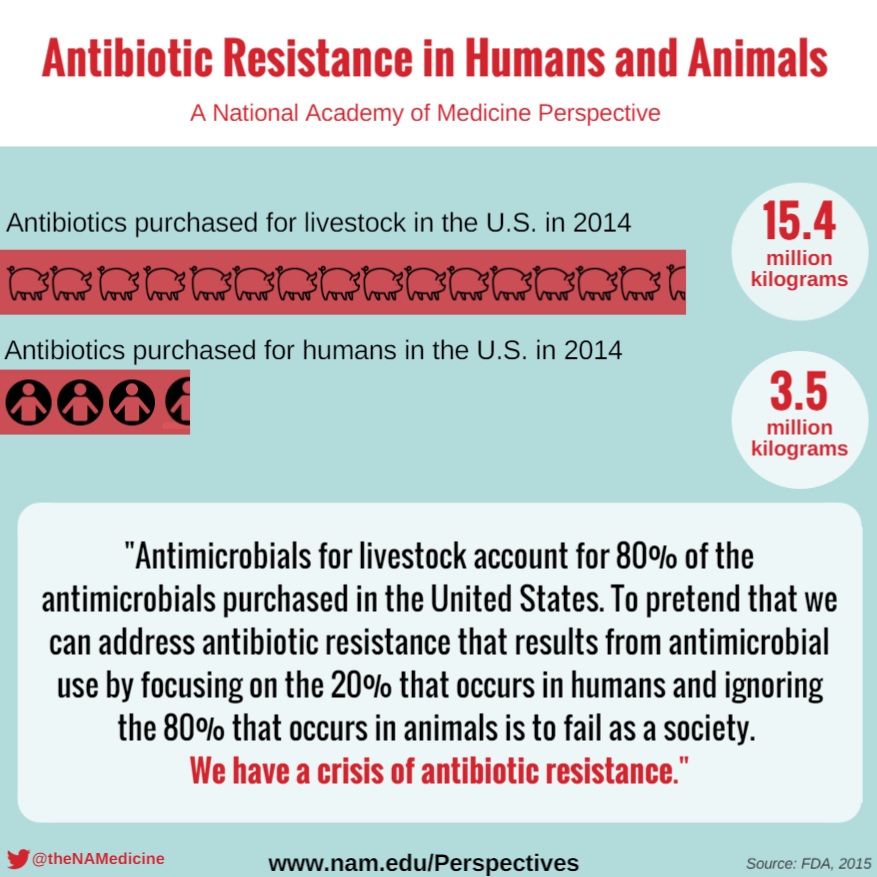
The staggering load of antimicrobial agents put into livestock in the Usa is difficult to fathom. In 2014, U.S. sales of antibiotics for livestock use totaled xv.four million kilograms of antimicrobial agents—which is 34 million pounds, or 17,000 tons (FDA, 2015). That is fourfold more antimicrobials than are purchased for utilize in humans in the United States (about 3.5 million kilograms). Thus, antimicrobials for livestock business relationship for fourscore percent of the antimicrobials purchased in the United States. The full use of antimicrobials in animals too reflects a more than than 20 pct increment in employ over the preceding 5 years, a period during which physicians and medical societies accept loudly called out warnings most the crisis of antibiotic resistance (Spellberg, 2008, 2009; Spellberg et al., 2011; Spellberg et al., 2013). To pretend that we can address the massive selective pressure level for antibiotic resistance that results from antimicrobial apply past focusing exclusively on the 20 per centum that occurs in humans and ignoring the 80 percent that occurs in animals is to fail as a society.
Antibiotic-resistant bacteria bred in livestock spread to humans by multiple routes. Resistant leaner from animals are shed into soil and groundwater, directly contaminate subcontract workers, who can then spread these bacteria through human communities via fomites and direct contact, and contaminate meat during the butchering process. Indeed, sampling of retail meat products in food stores consistently reveals high rates of Enterobacteriaceae in craven, turkey, pork, and beef (Elliott, 2015; Johnson et al., 2006; Making the world safety from superbugs, 2016; NARMS, 2013b; O'Neill, 2015; Sneeringer et al., 2015). An alarming proportion of these leaner are antibiotic-resistant, and when we handle the meat earlier cooking or ingest meat that is incompletely cooked, nosotros tin ingest the antibody-resistant bacteria as well. The U.South. Centers for Disease Control and Prevention has estimated that this route of transmission accounts for 20 percent of antibiotic-resistant infections in humans (CDC, 2013a,b; Making the globe safe from superbugs, 2016). The bodily percentage may well be substantially larger fifty-fifty before bookkeeping for the environmental spread of resistant leaner, because it is hard to account for additional rounds of human being-to-man transmission after the initial introduction of resistant bacteria from animals to humans.
National surveillance studies accept confirmed Dr. Levy's original 1976 observations on larger scales—the introduction of fluoroquinolones for livestock use in Spain in 1990 was followed by a marked, accelerated rising in fluoroquinolone-resistant Enterobacteriaceae infections in humans (Silbergeld et al., 2008). A similar phenomenon occurred when fluoroquinolones began to be used in livestock husbandry in the United States (Gupta et al., 2004).
Furthermore, Denmark and other countries in the European Union have successfully implemented bans on the routine use of antibiotics (whether for growth promotion or disease prevention), which has led to dramatic reductions in rates of clinical resistance in patients to some of the targeted antibiotics (DANMAP, 2015; Elliott, 2015; O'Neill, 2015; Robinson et al., 2016). Additional specific examples of success associated with reductions targeting a particular antibiotic class tin also be constitute in the United States and Canada. For example, in Quebec, eliminating cephalosporin use in broiler craven eggs led to precipitous declines in cephalosporin-resistant Enterobacteriaceae in both retail chicken meat and humans, even though human utilise of antibiotics held constant (Dutil et al., 2010). When the chicken manufacture partially resumed injecting cephalosporin in broiler chicken eggs in 2006–2007, cephalosporin resistance began to increase again in both animals and humans. Similarly, for use in poultry the Usa instituted a complete ban on fluoroquinolones in 2005 and a partial ban on cephalosporins in 2012 (NARMS, 2013a, 2014). Subsequently, FDA testing in 2022 plant no fluoroquinolone resistance in retail poultry samples and failing rates of ceftriaxone resistance in Salmonella (FDA, 2016).
These experiences are critical to agreement the potential for policy interventions. Radical skeptics who continue to ask for ever-more scientific precision may quibble and point out that in some instances restriction efforts have not reverted resistance rates. Even so, given the complex dynamics of resistance choice and transmission, failure in some interventions is not unexpected, and fifty-fifty slowing or halting an upwardly climb in resistance should be counted as a success. The signal is, in well-described, large-calibration cases, restrictions have worked. One cannot prove a negative, merely one can prove a positive. The fact that national policies of banning growth promotional and routine prophylactic use of antibiotics have led to reversions in antibiotic resistance rates in people reinforces the argument that feeding antibiotics to animals contributes to the spread of antibiotic resistance to human being populations.
We may bicker and quibble over what proportion of resistant infections in humans is caused by feeding antibiotics to animals. We may disagree over the extent and severity with which restrictions should be used. We may wish to understand more precisely at the molecular genetic level how leaner spread from animals to people. But two facts are unassailable: (1) adding antibiotics to animals' feed and water contributes to the spread of antibiotic-resistant bacteria to homo beings; and (2) many parties promote the routine apply of antibiotics in livestock specifically because they perceive (possibly incorrectly) that it enables the meat, poultry, and drug industries to maximize production and profits. Thus, a group of people in guild are using antibiotics injudiciously to mask inferior management practices for perceived gains in short-term profits, contributing to the spread of antibiotic-resistant bacteria to other people in society.
Excuses Grow
Later on years of dialogue, the patterns of this debate take settled into a anticipated norm. Here are some of the usual justifications proffered by agricultural and pharmaceutical manufacture spokespersons to prevent fifty-fifty small-scale restrictions on antibiotic use in livestock production.
1. Livestock will dice at alarming rates if we don't allow antibiotics to exist used for growth promotion or routine disease prophylaxis.
On its confront, this argument is absurd. Nosotros are simply 80 years into the antibacterial era. Chickens, turkeys, pigs, and cattle evolved tens of millions of years ago. They have only been exposed to antibiotics at appreciable levels in their feed for less than 0.000001 percent of their species' existence. Clearly they are capable of procreating and expanding their numbers without us feeding them antibiotics.
A counter argument may be that modern factory farming houses the animals so closely together, and in such unsanitary conditions, that antibiotics are necessary to keep them from getting sick. The solution then is self-evident: raise the animals in more humane, more germ-free conditions. Denmark and the netherlands, for instance, are raising large numbers of animals in high-intensity production systems without the use of antibiotics for either growth promotion or routine illness prevention, both of which purposes are prohibited (DANMAP, 2015; Netherlands Ministry of Economical Affairs, 2014). These countries rely on improved husbandry and nonantibiotic techniques such equally vaccines to keep their animals salubrious, and they have done so in a way in which profits have been maintained and no economical injury to farmers has been apparent (Netherlands Ministry of Economic Affairs, 2014, 2016).
Imagine the reaction of patients and the public if hospitals adopted a similar model for patients and crammed 10 patients into a infirmary room to relieve money, giving them all broad-spectrum antibiotics to endeavor to prevent the infections that would inevitably follow.
2. It will be too expensive to raise livestock without antibiotics.
Other countries, such equally Kingdom of denmark, have substantially expanded the number of animals produced later on banning growth-promoting and routine prophylactic uses of antibiotics in livestock (O'Neill, 2015). Similarly, the netherlands reduced antibiotic use in livestock by l percent between 2009 and 2013, while banning use for both growth promotion and disease prevention (Netherlands Ministry of Economic Diplomacy, 2014, 2016). Their businesses accept not suffered from the restriction, nor have farmers' or consumers' costs risen significantly. In addition, a growing number of farmers in the United States are successfully raising food animals while using antibiotics only for treating ill animals. California recently took an important step frontwards by prohibiting the regular use of antibiotics in livestock (whether for growth promotion or illness prevention) starting in 2022 and is also requiring the collection of information on antibody use for the kickoff fourth dimension in the U.s., which could further accelerate the chat if done well. (See: Livestock: Use of Antimicrobial Drugs, Senate Bill 27, chap. 758 (October ten, 2015). https://leginfo.legislature.ca.gov/faces/billNavClient.xhtml>bill_id=201520160SB27.) Do nosotros truly take such petty conviction in our American farmers outside of California that nosotros believe they cannot be equally successful as Danish or Dutch farmers?
Furthermore, as mentioned above, the assumption that routine use of antibiotics substantially enhances economic viability of livestock product may no longer be valid. Contempo economic reanalysis has indicated that the power of growth-promoting antibiotic use to improve agribusiness return on investment has been overrated—the exercise may now provide but a marginal economic advantage, if any (O'Neill, 2015; Robinson et al., 2016; Teillant and Laxminarayan, 2015). The cost of eliminating routine antibiotic use has been exaggerated.
3. The public will not tolerate any increase in meat cost associated with withdrawing antibiotics from livestock.
Quite to the contrary, the public is increasingly enervating meat from animals raised without antibiotics. Many food companies have begun to reply to this market forcefulness by moving toward purchasing meat from antibiotic-free vendors. These very big businesses/purchasers include Chipotle, Chick-fil-A, Costco, McDonalds, and Subway (Robinson et al., 2016). Within the concluding year, craven companies such as Perdue, Tyson, and Foster Farms accept made commitments to eliminate the routine employ of medically important antibiotics. They are conspicuously responding to market demand.
In 2012, a Consumer Reports survey found that 86 percent of consumers polled said that meat and poultry raised without antibiotics should be available in their local supermarket; more than lx percent said they would be willing to pay at least $0.05 cents per pound more for it, and nigh 40 percent said they would pay an extra $1 or more than per pound (Meat on drugs, 2012). Every bit the public has become more than educated and enlightened of the antibody resistance crisis, they are increasingly voting with their wallets. Sales estimates of meat raised without any antibiotics increased 25 percent from 2009 to 2011 (Perrone, 2012). The increase occurred despite an overall refuse in U.South. per capita meat consumption. USDA-certified organic meats—just one part of the market for meat raised without routine use of antibiotics—were the fastest-growing segment of the $31 billion organic foods industry in 2011 (Organic Trade Association, 2012). In 2013, sales of organic meat, poultry, and fish were up 11 percent over the prior year, to $675 million (Organic Trade Association, 2014). Ultimately, market forces may well be a meaning part of the solution to this societal conundrum in the United states.
iv. Near antibiotics used in livestock are non "medically important."
This merits is patently false. Of the antibiotics sold for use in livestock in 2014, 9.5 million kilograms were identical or very similar to those used in humans (FDA, 2015). Furthermore, some of the drugs that are not considered "medically important" are similar in mechanism to antibiotics used in humans and have the substantial potential to trigger cantankerous-resistance (Marshall and Levy, 2011).
In addition, the currently used definition of which antibiotics are medically important is incomplete and evolving. I antibiotic that is not considered medically of import is bacitracin, but information technology is used in patients quite commonly, admitting topically rather than systemically. If we lose bacitracin for topical use, we will be forced to apply other antibiotics in its identify. Therefore, some of the agents that are described every bit "not medically of import" are in fact medically of import to physicians. Furthermore, even the FDA acknowledges that other antibiotics may go medically important: it uses the term "not currently medically important" to draw these antibiotics in its latest report on sales of antibiotics for nutrient animals (FDA, 2015).
Finally, considering many antibiotic resistance mechanisms are genetically linked (physically connected) in genomes or mobile genetic elements, use of ane antimicrobial agent can select for resistance to another, even if the agents are unrelated with respect to chemic structure, target, or resistance mechanism (Marshall and Levy, 2011). Thus, exposure to antimicrobial agents that are non used in human medicine has the potential to select for resistance to agents that are used in human medicine. We should not let this risk to exist dismissed categorically by those who have a vested interest in continuing electric current farming practices.
Conclusions
The global human customs has an ongoing and worsening crisis of antibiotic-resistant infections in patients. Nosotros cannot count on new antibiotics to salvage the states from this crisis—the pipeline is inadequate. We must do a much better job of preserving the effectiveness of the antibiotics nosotros have now. We must therefore utilise fewer antibiotics. Because most lxxx percentage of antimicrobial use in the United States is in livestock, nosotros must do a much better job of reducing antibiotic apply in livestock equally well as in humans.
Information technology is important that we not be bogged down or distracted past quibbles over the minutiae of the molecular mechanisms past which antibiotic resistance spreads from animals to humans or the precise proportion of antibiotic-resistant infections in humans that is caused by antibiotic utilize in animals. The fundamental signal is that antibiotic-resistant microbes can motion from livestock fed antibiotics to humans, that patients are harmed as a result of this process, and that, in some countries, national policies eliminating growth promotion and routine prophylactic use take reverted or slowed antibiotic resistance rates.
Thus, from a policy perspective, the real question is, what is the "pro" of antimicrobial utilise in animals that might cause society to agree to accept on the respective "con"—the risk of harming humans by this utilize? The pro is the ability of industrial farms to take shortcuts in animal husbandry to increase the potential for turn a profit. And so this upshot—like and so many others—boils down to societal priorities. This is non a science question, it is a policy question. Practise we, as a gild, believe that livestock producers should be afforded the correct to profligate antimicrobial apply by growing animals in unsanitary and crowded conditions despite the clear associated risk of transmission of antibody resistant bacteria from animals to humans, resulting in damage to humans? That is the question that confronts united states as a gild.
Finally, a disquisitional lesson from this dialogue has non been clearly stated. If we reduce the amount of antibiotics fed to animals by 50 percent per animal, but nosotros grow twice as many animals, nosotros still will exist exposing the bacteria in the food production environment to the same corporeality of antibiotics, driving antibiotic resistance. As a society, if we want to reduce the selection of antibiotic-resistant bacteria, and thereby reduce the risk of antibiotic-resistant infections, we should exist consuming less meat. This real, transformative opportunity has had insufficient attention at the level of national health and commerce policy.
Notation: Affiliations for the authors of this paper are shown for identification purposes only. The opinions stated in the manuscript exercise not reflect or represent those of the institutions or employers shown.
Download the graphic below and share it on social media!
References
- Animate being Health Institute. 2008. 2007 Antibiotics sales. Available at: http://www.ahi.org/archives/2008/11/2007-antibiotics-sales/ (accessed May fourteen, 2016).
- Brook, I., and East. H. Frazier. 1995. Clinical features and aerobic and anaerobic microbiological characteristics of cellulitis. Archives of Surgery 130(7):786–792. https://doi.org/10.1001/archsurg.1995.01430070108024
- Carratala, J., B. Roson, Due north. Fernandez-Sabe, E. Shaw, O. del Rio, A. Rivera, and F. Gudiol. 2003. Factors associated with complications and mortality in adult patients hospitalized for infectious cellulitis. European Journal of Clinical Microbiology and Infectious Diseases 22(iii):151–157. https://doi.org/10.1007/s10096-003-0902-x
- CDC (U.S. Centers for Disease Control and Prevention). 2013a. Antibiotic resistance from the farm to the tabular array. Available at: http://world wide web.cdc.gov/foodsafety/challenges/from-farm-to-tabular array.html (accessed May 17, 2016).
- CDC. 2013b. Antibody resistant threats in the U.s.a., 2013. Available at: http://world wide web.cdc.gov/drugresistance/threat-report-2013/pdf/ar-threats-2013-508.pdf (accessed Nov 16, 2013).
- Cho, I., S. Yamanishi, L. Cox, B. A. Methe, J. Zavadil, K. Li, Z. Gao, D. Mahana, K. Raju, I. Teitler, H. Li, A. Five. Alekseyenko, and Yard. J. Blaser. 2012. Antibiotics in early life alter the murine colonic microbiome and adiposity. Nature 488(7413):621–626. https://doi.org/10.1038/nature11400
- Coates, Thousand. E., C. D. Dickinson, G. F. Harrison, S. One thousand. Kon, S. H. Cummins, and Westward. F. Cuthbertson. 1951. Style of action of antibiotics in stimulating growth of chicks. Nature 168(4269):332. https://doi.org/10.1038/168332a0
- DANMAP (Danish Integrated Antimicrobial Resistance Monitoring and Enquiry Programme). 2015. Danmap 2014: Use of antimicrobial agents and occurrence of antimicrobial resistance in bacteria from food animals, food and humans in Kingdom of denmark. Bachelor at: http://www.danmap.org/~/media/Projekt%20sites/Danmap/DANMAP%20reports/DANMAP%202014/Danmap_2014.ashx (accessed May xiv, 2016).
- Davis, G. S., and L. B. Price. 2016. Recent research examining links among klebsiella pneumoniae from food, food animals, and homo extraintestinal infections. Current Ecology Health Reports iii(ii):128–135. https://doi.org/10.1007/s40572-016-0089-9
- Davis, Grand. Due south., K. Waits, L. Nordstrom, B. Weaver, M. Aziz, L. Gauld, H. Grande, R. Bigler, J. Horwinski, S. Porter, One thousand. Stegger, J. R. Johnson, C. G. Liu, and 50. B. Price. 2015. Intermingled klebsiella pneumoniae populations between retail meats and human being urinary tract infections. Clinical Infectious Diseases 61(6):892–899. https://doi.org/10.1093/cid/civ428
- Diekema, D. J., M. A. Pfaller, F. J. Schmitz, J. Smayevsky, J. Bell, R. N. Jones, and M. Beach. 2001. Survey of infections due to staphylococcus species: Frequency of occurrence and antimicrobial susceptibility of isolates collected in the United States, Canada, Latin America, Europe, and the Western Pacific Region for the lookout man antimicrobial surveillance programme, 1997–1999. Clinical Infectious Diseases 32(Suppl 2):S114–S132. https://doi.org/10.1086/320184
- Diekema, D. J., Due south. East. Beekmann, Grand. C. Chapin, K. A. Morel, Due east. Munson, and G. V. Doern. 2003. Epidemiology and issue of nosocomial and community-onset bloodstream infection. Journal of Clinical Microbiology 41(8):3655–3660. https://doi.org/x.1128/JCM.41.8.3655-3660.2003
- Dutil, L., R. Irwin, R. Finley, L. K. Ng, B. Avery, P. Boerlin, A. Grand. Bourgault, L. Cole, D. Daignault, A. Desruisseau, Due west. Demczuk, L. Hoang, G. B. Horsman, J. Ismail, F. Jamieson, A. Maki, A. Pacagnella, and D. R. Pillai. 2010. Ceftiofur resistance in Salmonella enterica serovar heidelberg from craven meat and humans, Canada. Emerging Infectious Diseases xvi(1):48–54. https://doi.org/10.3201/eid1601.090729
- Elliott, K. 2015. Antibody on the subcontract: Agriculture's role in drug resistance. Center for Global Development. Available at: http://www.cgdev.org/sites/default/files/CGD-Policy-Paper-59-Elliott-AntibioticsFarm-Agriculture-Drug-Resistance.pdf (accessed May 8, 2016).
- European Centre for Illness Prevention and Control. 2013. Antimicrobial resistance surveillance in Europe 2012. Almanac Report of the European Antimicrobial Resistance Surveillance Network (EARS-Net). Stockholm: European Eye for Disease Prevention and Control.
- FDA (U.Due south. Nutrient and Drug Administration). 2015. Summary study on antimicrobials sold or distributed for use in food-producing animals. Available at: http://www.fda.gov/downloads/ForIndustry/UserFees/AnimalDrugUserFeeActADUFA/UCM476258.pdf (accessed May viii, 2016).
- FDA. 2016. FDA NARMS retail meat interim report for salmonella shows encouraging early on trends continue; includes whole genome sequencing data for the starting time time. Available at: http://world wide web.fda.gov/downloads/AnimalVeterinary/SafetyHealth/AntimicrobialResistance/NationalAntimicrobialResistanceMonitoringSystem/UCM498134.pdf (accessed May 8, 2016).
- Gupta, A., J. M. Nelson, T. J. Barrett, R. Five. Tauxe, S. P. Rossiter, C. R. Friedman, K. Due west. Joyce, G. Eastward. Smith, T. F. Jones, Yard. A. Hawkins, B. Shiferaw, J. L. Beebe, D. J. Vugia, T. Rabatsky-Ehr, J. A. Benson, T. P. Root, F. J. Angulo, and Due north. Westward. Grouping. 2004. Antimicrobial resistance among campylobacter strains, United states, 1997–2001. Emerging Infectious Diseases 10(6):1102–1109. https://doi.org/10.3201/eid1006.030635
- IDSA (Infectious Disease Order of America). 2004. Bad bugs, no drugs. White Paper. Alexandria, VA: Infectious Diseases Society of America. Available at: https://www.reactgroup.org/uploads/react/resources/94/Bad%20Bugs%20No%20Drugs.en.140.pdf (accessed July 22, 2020).
- Institute of Medicine. 2010.Antibiotic Resistance: Implications for Global Wellness and Novel Intervention Strategies: Workshop Summary. Washington, DC: The National Academies Press. https://doi.org/x.17226/12925
- Johnson, J. R., Thousand. A. Kuskowski, M. Menard, A. Gajewski, Chiliad. Xercavins, and J. Garau. 2006. Similarity between human being and chicken Escherichia coli isolates in relation to ciprofloxacin resistance status. Journal of Infectious Diseases 194(ane):71–78. https://doi.org/10.1086/504921
- Laupland, 1000. B., and D. 50. Church. 2014. Population-based epidemiology and microbiology of community-onset bloodstream infections. Clinical Microbiology Reviews 27(4):647–664. https://doi.org/10.1128/CMR.00002-14
- Laupland, G. B., D. B. Gregson, W. Due west. Flemons, D. Hawkins, T. Ross, and D. L. Church. 2007. Brunt of community-onset bloodstream infection: A population-based cess. Epidemiology and Infection 135(half-dozen):1037–1042. https://doi.org/x.1017/S0950268806007631
- Levy, S. B., M. B. FitzGerald, and A. B. Macone. 1976. Changes in intestinal flora of farm personnel after introduction of a tetracycline-supplemented feed on a farm. New England Journal of Medicine 295(11):583–588. https://doi.org/10.1056/NEJM197609092951103
- Making the world safe from superbugs. 2016. Consumer Reports. Available at: http://www.consumerreports.org/cro/health/making-the-earth-rubber-from-superbugs/alphabetize.htm (accessed May 8, 2016).
- Marshall, B. M., and Due south. B. Levy. 2011. Nutrient animals and antimicrobials: Impacts on human health. Clinical Microbiology Reviews 24(4):718–733. https://doi.org/x.1128/CMR.00002-11
- Meat on drugs. 2012. Consumer Reports. Available at: http://www.consumerreports.org/content/dam/cro/news_articles/health/CR%20Meat%20On%20Drugs%20Report%2006-12.pdf (accessed May 8, 2016.)
- Moore, P. R., A. Evenson, T.D. Luckey, E. McCoy, C.A. Elvehjem, and Due east.B. Hart. 1946. Use of sulfasuxidine, streptothricin, and streptomycin in nutritional studies with the chick. Journal of Biological Chemistry 165(2):437–441. Available at: https://pdfs.semanticscholar.org/d661/185796a812473bbfac31aea96eabac2c4de5.pdf (accessed July 22, 2020).
- NARMS (National Antimicrobial Resistance Monitoring Arrangement). 2013a. 2012 Retail meat report. U.S. Nutrient and Drug Administration. Available at: http://world wide web.fda.gov/downloads/AnimalVeterinary/SafetyHealth/AntimicrobialResistance/NationalAntimicrobialResistanceMonitoringSystem/UCM442212.pdf (accessed May 8, 2016).
- NARMS. 2013b. The national antimicrobial resistance monitoring system: Enteric bacteria. U.South. Nutrient and Drug Assistants. Available at: http://www.fda.gov/downloads/AnimalVeterinary/SafetyHealth/AntimicrobialResistance/NationalAntimicrobialResistanceMonitoringSystem/UCM453398.pdf (accessed May 8, 2016).
- NARMS. 2014. NARMS integrated report: 2012–2013. U.S. Food and Drug Administration. Available at: http://world wide web.fda.gov/downloads/AnimalVeterinary/SafetyHealth/AntimicrobialResistance/NationalAntimicrobialResistanceMonitoringSystem/UCM453398.pdf (accessed May 8, 2016).
- Netherlands Ministry building of Economic Affairs. 2014. Reduced and responsible: Use of antibiotics in food-producing animals in holland. Available at:https://www.government.nl/documents/leaflets/2014/02/28/reduced-and-responsible-use-ofantibiotics-in-food-producing-animals-in-the-netherlands (accessed May 8, 2016).
- Netherlands Ministry building of Economical Diplomacy. 2016. AMR next: European union Antimicrobial Resistance One Health Ministry Conference 2016. Bachelor at: https://world wide web.regime.nl/topics/antibioticresistance/documents/leaflets/2016/04/18/factsheet-eu-antimicrobial-resistance-i-healthministerial-conference-2016 (accessed May 8, 2016).
- Nordstrom, L., C. Grand. Liu, and L. B. Toll. 2013. Foodborne urinary tract infections: A new paradigm for antimicrobial-resistant foodborne disease. Frontiers in Microbiology 4:29. https://doi.org/10.3389/fmicb.2013.00029
- O'Neill, J. 2015. Antimicrobials in agronomics and the surroundings: Reducing unnecessary use and waste material: The review on antimicrobial resistance. Available at: http://amrreview.org/sites/default/files/Antimicrobials%20in%20agriculture%20and%20the%20environment%20-%20Reducing%20unnecessary%20use%20and%20waste.pdf (accessed May eight, 2016).
- Organic Trade Clan. 2012. Consumer-driven U.Southward. organic market surpasses $31 billion in 2011. Available at: https://world wide web.ota.com/news/press-releases/17093 (accessed May eight, 2016).
- Organic Trade Association. 2014. American appetite for organic products breaks through $35 billion marking. Available at: https://www.ota.com/news/press-releases/17165 (accessed May viii, 2016).
- PCAST (President'due south Council of Advisors on Science and Technology). 2014. Report to the president on combating antibiotic resistance. Executive Part of the President. Available at: http://www.whitehouse.gov/sites/default/files/microsites/ostp/PCAST/pcast_carb_report_sept2014.pdf (accessed January ii, 2015).
- Penicillin's finder assays its time to come. 1945. New York Times, June 26. Available at: https://www.nytimes.com/1945/06/26/archives/penicillins-finder-assays-its-hereafter-sir-alexander-fleming-says.html (accessed July 22, 2020).
- Perrone, Thou. 2012. Does giving antibiotics to animals injure humans? The states Today, Apr 20. Bachelor at: http://usatoday30.usatoday.com/news/health/story/2012-04-20/antibiotics-animals-humanmeat/54434860/one (accessed May 8, 2016).
- Poultry Site. Antibiotic use in U.S. animals rises in 2004. 2005. Bachelor at: http://world wide web.thepoultrysite.com/poultrynews/7985/antibiotic-use-in-us-animals-rises-in-2004/ (accessed May 14, 2016).
- Robinson, T. P., H. F. Wertheim, 1000. Kakkar, S. Kariuki, D. Bu, and L. B. Cost. 2016. Beast production and antimicrobial resistance in the clinic. Lancet 387(10014):e1–3. https://doi.org/x.1016/S0140-6736(15)00730-viii
- Russo, T. A., and J. R. Johnson. 2003. Medical and economic impact of extraintestinal infections due to Escherichia coli: Focus on an increasingly of import endemic problem. Microbes and Infection 5(v):449–456. https://doi.org/10.1016/s1286-4579(03)00049-2
- Sigurdsson, A. F., and South. Gudmundsson. 1989. The etiology of bacterial cellulitis every bit determined past fineneedle aspiration. Scandinavian Periodical of Infectious Diseases 21(five):537–542. https://doi.org/ten.3109/00365548909037882
- Silbergeld, E. K., J. Graham, and 50. B. Price. 2008. Industrial food animal production, antimicrobial resistance, and human health. Almanac Review of Public Health 29:151–169. https://doi.org/10.1146/annurev.publhealth.29.020907.090904
- Smith, T. C. 2015. Livestock-associated Staphylococcus aureus: The United States experience. PLoS Pathogens eleven(ii):e1004564. https://doi.org/ten.1371/journal.ppat.1004564
- Smith, T. C., and S. E. Wardyn. 2015. Human infections with Staphylococcus aureus cc398. Current Ecology Wellness Reports two(one):41–51. https://doi.org/x.1007/s40572-014-0034-8
- Sneeringer, S., J. MacDonald, N. Fundamental, W. McBride, and K. Mathews. 2015. Economic science of antibiotic use in U.South. livestock product. U.Due south. Department of Agriculture. Available at: http://www.ers.usda.gov/media/1950577/err200.pdf (accessed May eight, 2016).
- Spellberg, B. 2008. Antibody resistance and antibody development. Lancet Infectious Diseases viii:211–212. https://doi.org/10.1016/S1473-3099(08)70048-3
- Spellberg, B. 2009. Ascent plague: The global threat from deadly bacteria and our dwindling arsenal to fight them. New York: Prometheus Press.
- Spellberg, B. 2010. The antibacterial pipeline: Why is information technology drying up, and what must exist done about it? In Antibiotic resistance: Implications for global health and novel intervention strategies: Workshop summary. Washington, DC: The National Academies Printing. Pp. 299–332.
- Spellberg, B. 2011. The antibiotic crisis: Can we reverse 65 years of failed stewardship? Athenaeum of Internal Medicine 171(12):1080–1081. https://doi.org/x.1001/archinternmed.2011.26
- Spellberg, B., R. Guidos, D. Gilbert, J. Bradley, H. W. Boucher, West. M. Scheld, J. G. Bartlett, and J. Edwards, Jr. 2008a. The epidemic of antibiotic-resistant infections: A call to action for the medical customs from the Infectious Diseases Order of America. Clinical Infectious Diseases 46(2):155–164. https://doi.org/10.1086/524891
- Spellberg, B., G. H. Talbot, E. P. Contumely, J. S. Bradley, H. Due west. Boucher, and D. Gilbert. 2008b. Recommended design features of future clinical trials of anti-bacterial agents for customs-caused pneumonia. Position Newspaper. Clinical Infectious Diseases 47(S3):S249–S265. Available at: https://www.ncbi.nlm.nih.gov/pmc/articles/PMC2827629/ (accessed July 22, 2020).
- Spellberg, B., G. H. Talbot, H. Westward. Boucher, J. S. Bradley, D. Gilbert, W. M. Scheld, J. E. J. Edwards, and J. G. Bartlett. 2009. Antimicrobial agents for complicated pare and peel structure infections: Justification of not-inferiority margins in the absence of placebo-controlled trials. Clinical Infectious Diseases 49:383–391. https://doi.org/10.1086/600296
- Spellberg, B., M. Blaser, R. Guidos, H. W. Boucher, J. S. Bradley, B. Eisenstein, D. Gerding, R. Lynfield, L. B. Reller, J. King, D. Schwartz, E. Septimus, F. C. Tenover, and D. N. Gilbert. 2011. Combating antimicrobial resistance: Policy recommendations to save lives. Clinical Infectious Diseases 52(S5):S397–S428. https://doi.org/10.1093/cid/cir153
- Spellberg, B., J. Thou. Bartlett, and D. N. Gilbert. 2013. The future of antibiotics and resistance. New England Journal of Medicine 368(iv):299–302. https://doi.org/10.1056/NEJMp1215093
- Spellberg, B., A. Srinivasan, and H. F. Chambers. 2016. New societal approaches to empowering antibody stewardship. JAMA 315(12):1229–1230. https://doi.org/10.1001/jama.2016.1346
- Stokstad, East. Fifty. R., and T. H. Jukes. 1950. Further observations on the "beast protein factor." Experimental Biology and Medicine 73:523–528. https://doi.org/ten.3181/00379727-73-17731
- Teillant, A., and R. Laxminarayan. 2015. Economic science of antibiotic use in U.Due south. swine and poultry product. Choices. Bachelor at: http://www.choicesmagazine.org/choices-mag/theme-articles/themeoverview/economics-of-antibiotic-use-in-us-swine-and-poultry-production (accessed May fourteen, 2016).
- USDA (U.S. Department of Agriculture). 2016a. Livestock slaughter annual summary. Available at: http://usda.mannlib.cornell.edu/MannUsda/viewDocumentInfo.do?documentID=1097 (accessed May fourteen, 2016).
- USDA. 2016b. Poultry slaughter. Available at: http://usda.mannlib.cornell.edu/MannUsda/viewDocumentInfo.exercise?documentID=1131 (accessed May fourteen, 2016).
- WHO (Globe Health Organization). 2012. The evolving threat of antimicrobial resistance: Options for action. Bachelor at: http://apps.who.int/iris/bitstream/10665/44812/one/9789241503181_eng.pdf (accessed May eight, 2016).
- WHO. 2014. Antimicrobial resistance: Global written report on surveillance. Available at: http://apps.who.int/iris/bitstream/10665/112642/ane/9789241564748_eng.pdf?ua=1 (accessed May v, 2014).
- Wisplinghoff, H., H. Seifert, Due south. M. Tallent, T. Bischoff, R. P. Wenzel, and Grand. B. Edmond. 2003a. Nosocomial bloodstream infections in pediatric patients in United States hospitals: Epidemiology, clinical features and susceptibilities. Pediatric Communicable diseases Journal 22(8):686–691. https://doi.org/10.1371/journal.pone.0068144
- Wisplinghoff, H., H. Seifert, R. P. Wenzel, and G. B. Edmond. 2003b. Current trends in the epidemiology of nosocomial bloodstream infections in patients with hematological malignancies and solid neoplasms in hospitals in the Us. Clinical Infectious Diseases 36(nine):1103–1110. https://doi.org/x.1086/374339
- Wisplinghoff, H., T. Bischoff, S. Thousand. Tallent, H. Seifert, R. P. Wenzel, and M. B. Edmond. 2004. Nosocomial bloodstream infections in U.s.a. hospitals: Analysis of 24,179 cases from a prospective nationwide surveillance study. Clinical Infectious Diseases 39(3):309–317. https://doi.org/10.1086/421946
- World Economical Forum. 2013. Global risks. 8th ed. Bachelor at: http://www3.weforum.org/docs/WEF_GlobalRisks_Report_2013.pdf (accessed Nov xvi, 2013).
Source: https://nam.edu/antibiotic-resistance-in-humans-and-animals/
0 Response to "What Complications Can Occur From Antibiotic Resistance, Both in Humans and in Livestock?"
Post a Comment